Tsarnaev as Enemy Combatant?

by Travis Normand

I heard a short audio clip on NPR yesterday concerning whether or not Dzhokhar Tsarnaev should be charged (or treated) as an “enemy combatant.”  You can listen to the audio of this discussion HERE (on NPR).

Notwithstanding the debate on whether or not Tsarnaev should be treated as an enemy combatant, White House press secretary Jay Carney says Tsarnaev will not be charged as an enemy combatant and instead will face trial in a federal court.

The reasoning Carney gives has nothing to do with whether or not Tsarnaev meets the criteria of being an enemy combatant but instead focuses on the fact that “when it comes to United States citizens, it is against the law to try them in military commissions.”  Carney’s answer is an interesting one considering that many are calling for Tsarnaev to be labeled as an enemy combatant for intelligence gathering purposes only and that he should still be tried in Federal Court (and not in a military commission).  In other words, if Tsarnaev can be designated as an enemy combatant, and still be tried in Federal Court, then Carney’s answer doesn’t make much sense.

Continue reading

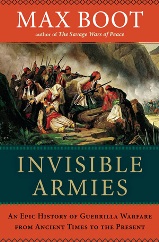
Invisible Armies: A book and interactive timeline

by Jessica Poarch
????????????????????????????????

NIAC style warfare -armed conflict that is not between two governments with uniformed soldiers – has been around since ancient times. In his new book, Invisible Armies: An Epic History of Guerrilla Warfare from Ancient Times to the Present, Max Boot attempted to write a “one-stop destination…for the general reading public interested [in the subject of guerrilla warfare]*.” He begins the book by discussing the origins of guerrilla warfare and ends with current conflicts.* 

For more information on the book and an overview of the text visit the Council on Foreign Relation’s website.

Also on the CFR’s website is an interesting interactive timeline/ tracker that shows conflicts from 1775-2012. Here the reader can sort by Region, Country or Outcome to explore conflict through the centuries.

*Page xxi of Invisible Armies: An Epic History of Guerrilla Warfare from Ancient Times to the Present by Max Boot

Hanging Airplanes & Drones – Past and Present

YP-38

by Travis Normand

I wanted to share this as I thought it was an interesting distinction between past and present methods of warfare.

When I was a kid, I thought the coolest fighter planes were the P-38 and the F-16.  However, my high opinion of these two aircrafts probably had something to do with my grandfather’s influence.

My paternal grandfather served in WWII (U.S. Army), was stationed in Europe, and had worked on P-38s during the war.  It is no surprise that he told me that the P-38 was probably the “best of the best!”    After the war, my grandfather attended Texas A&M where he earned his engineering degree and later helped develop the F-16.  Again, it’s no coincidence that I grew up thinking the F-16 was on par with the P-38.

Continue reading

Ownership of “International Humanitarian Law”

by Jessica Poarch

Who should be responsible for the stewardship of IHL (LOAC)? In his article published in the Winter 2013 Issue of the International Judicial Monitor, Richard J. Goldstone (First Chief Prosecutor for the ICTY) explains, “Until recent decades [IHL was] owned and fashioned by the military. They did not fall within the remit of civilian authorities. That ownership appears to have become lost and it has somehow, perhaps unwittingly, been ceded to civilian governments and to non-governmental organizations, both domestic and global. Today, this development appears to be taken very much for granted. This is unfortunate. We should examine the reason for this shift, ask whether a movement back would not be timely, sensible, and very much in the interests of the military establishment and, indeed, governments and their citizens.”

Goldstone’s article begins by explaining the history of IHL.  However, his article takes a curious turn towards the U.S.’s involvement with the international tribunal that is setup to prosecute war crimes and the Rome Statute (the Treaty that established the International Criminal Court (ICC)).

Goldstone explains that, although the U.S. has been very involved in aiding the international courts, it has refused to ratify the Rome Statute for fear that allowing U.S. citizens to fall under the jurisdiction of an International Tribunal would result in politically motivated prosecutions.

The author concludes: “In the result the ICC has jurisdiction to investigate and prosecute the nationals of any state for war crimes allegedly committed in the territory of one of the 121 nations that have to date ratified the Rome Statute. As remote as it might be, I would suggest that if a United States citizen were to be charged by the Court it would be highly embarrassing for his or her government and especially the military. Such a situation could be avoided if the United States military authorities were to regain ownership of humanitarian law. The most urgent and direct way of accomplishing this is for Congress to enact legislation that makes the core international war crimes defined in the Rome Treaty crimes under the domestic law of the United States. It would then be for the military judicial authorities to police those laws and investigate any of its own members who are alleged to have violated them. That would effectively oust the jurisdiction of the ICC.”

I find the author’s suggestion rather interesting.  U.S. Military personnel fall under the jurisdiction of the Uniform Code of Military Justice (UCMJ), which, if my understanding is correct, provides for the prosecution of war crimes. This suggest to me that the U.S. Military does have “ownership” of War Crimes prosecution in the U.S. and no additional legal framework is required to “oust” the jurisdiction of the ICC.

War Crimes prosecution is a delicate issue; if left completely up to the military it runs the risk of becoming victor’s justice but if shifted completely into the jurisdiction of the international tribunals, States must cede a certain level of sovereignty to that entity. It seems to me that this is not something the U.S. is willing to do regardless of if there is a domestic legal system in place that would prevent the ICC from gaining jurisdiction of a U.S. citizen.

* * * * *

*A discussion of War Crimes under the Rome Statue:  See Section 1 of “War Crime under the Rome Statute of the International Criminal Court, with a Special Focus on the Negotiations on the Elements of Crimes” by Knut Dormann.

*For more details about prosecuting War Crimes under the UCMJ please visit http://www.au.af.mil/au/awc/awcgate/awc-law.htm#warcrimes. There you will find multiple resources on the issue of War Crimes and Crimes Against Humanity.
The opposite of peace is chaos, not war.

by Travis Normand

I stumbled upon the following quote and thought it was highly relevant to the study of the LOAC.

[Emphasis Added]

This week I have been doing some reading for a class I’m taking at ESR called Images of God. While studying the image of God as Warrior my class read an article by an Old Testament professor at Harvard, Paul Hanson, who wrote about the concept of Peace as Shalom in the early Old Testament. This concept doesn’t translate directly into the way we use the English version of it. Hanson said many interesting things -among them that the opposite of peace is not war. It is chaos. Webster’s Dictionary gives a definition of “chaos” as a word that means the disorder of formless matter and infinite space. Hanson described the ancient Israelites sharing with their neighbors over the cook pot, their basic view that the world was situated precariously between order and chaos. Order is defined as a life-enhancing condition which the creator God maintains by holding the unruly forces of chaos in check. [1]

Continue reading

Targeted Killings of Americans: Three Things to Know [CFR.org]

by Travis Normand

The following video and article were originally created and posted by CFR.org.  You can visit their site HERE.

As for the three points discussed by Matthew C. Waxman (in the following video), I think the first point is the most important. After all, whether or not the U.S. is at war determines if the LOAC paradigm is applicable to the situation.

Continue reading

JustWarTheory.com

by Travis Normand

I have posted before that I would share any links that I found to be particularly interesting.  After all, I add so many links to the left hand column of this blog, that I have no doubt many of them go unnoticed.  However, I recently stumbled upon a very interesting and informative site titled JustWarTheory.com.  It is a simplistic site, but is full of information and links to sources and scholarly material.  It is worth checking out if you haven’t done so already.

You can find the site by clicking HERE, or going to JustWarTheory.com.

Here is the header from the JustWarTheory.com site:

JustWarTheory.com is a free, non-profit, critically annotated aid to philosophical studies of warfare. It is owned and maintained by Mark Rigstad, Associate Professor and Chair of Philosophy at Oakland University (a “Military Friendly School”) that offers in-state tuition to all U.S. military veterans. It is supported through the sale of JWT-shirts. All profits (if any) go to UNICEF.


The war on terror is without geographically defined battlefields

by Travis Normand

An article appeared yesterday (Feb. 14, 2013) on the HuffingtonPost.com titled Drone Attacks Spur Legal Debate On Definition of ‘Battlefield.’

The debate concerning the geographic limits of the battlefield is not a new one.  In fact, the debate has been ongoing at least since the U.S. declared that it was engaged in a “War on Terror.”  After all, terrorist groups such as al-Qaeda are organizations and they typically have no geographic nation or state.  So, contrary to the traditional war paradigm we are used to, when the U.S. sent troops into Afghanistan to combat the al-Qaeda organization, the U.S. was not going to war with Afghanistan.

However, the author of the above referenced HuffingtonPost.com article suggests that a 2002 Drone attack in Yemen is what “blew apart notions of ‘war’ and ‘battlefield’ which has guided the application of the legal traditions, treaties and laws of armed conflict for centuries.”

Continue reading

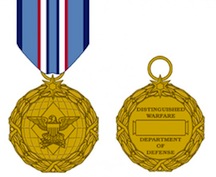
Pentagon to Award Medals for Drone Strikes

Distinguished Warfare Medal-17K

This image released by the Department of Defense shows the . . . newly announced Distinguished Warefare Medal. The Pentagon is creating the new medal that can be awarded to troops who have a direct impact on combat operations but do it from afar. The medal will be awarded to individuals for “extraordinary achievement” related to a military operation. (AP Photo/Department of Defense)Link to source

Click HERE to see enlarged photo of medal.

Continue reading

DOJ “white paper” memo provides legal justification for drone strikes against US citizens

by Travis Normand

Reaper UAV Taxis at Kandahar Airfield

Here is a link to the memo that was obtained by NBC.com, as well as the accompanying story that NBC posted.