[OUPblog] Killing journalists in wartime: a legal analysis

by Jessica Poarch

Have you ever sat back and thought about how many different groups of people are on the ground in the middle of an armed conflict? Lots but the Law of Armed Conflict recognizes only three – civilians, combatants, and medical personnel.

One example of this principle can be seen through Sandesh Sivakumaran’s recent post to the Oxford University Press’s Blog analyzing how the LOAC applies to journalist reporting from an armed conflict. In his post, Mr. Sivakumaran correctly points out that unless they are members of the armed forces, journalist are treated as civilians. Therefore, they can not lawfully be the object of attack and must be considered when determining the proportionality of an attack.

[Article Review] The Perilous Position of the Laws of War

by Jessica Poarch

In his article published in Harvard Law School’s National Security Journal, Charles Kels argues that the debate surrounding the application of the LOAC to the war against al-Qaeda and targeted killings often crosses the paradigm boundary between jus ad bellum (the law governing the use of force) and jus in bello (the laws in war) to the detriment of LOAC’s fundamental aim, the protection of humanity.

He concludes, “LOAC is apolitical. Adherence to it does not legitimize an unlawful resort to force, just as its violation—unless systematic—does not automatically render one’s cause unjust. The answer for those who object to U.S. targeted killing and indefinite detention is not to apply a peace paradigm that would invalidate LOAC and undercut the belligerent immunity of soldiers, but to direct their arguments to the political leadership regarding the decision to use force in the first place. Attacking LOAC for its perceived leniency and demanding the “pristine purity” of HRL in military operations is actually quite dangerous and counterproductive from a humanitarian perspective, because there remains the distinct possibility that the alternative to LOAC is not HRL but “lawlessness.” While there are certainly examples of armies that have acquitted themselves quite well in law enforcement roles—and while most nations do not subscribe to the strict U.S. delineation between military and police forces—the vast bulk of history indicates that in the context of armed hostilities, LOAC is by far the best case scenario, not the worst.”

In my opinion the article is worth reading. For starters, it provides a good reminder of the fundamental debate surrounding the application of the LOAC to America’s use of force against terrorist organizations. The author spends sometime at the beginning of the article detailing the history of the Geneva Conventions and the types of armed conflicts. He then outlines the current debate and the places where they trip the line between the two paradigms of International Law. Most importantly, however, this article adds an outlook not often noted in the LOAC debates – the importance of LOAC to the military.

Obama administration to codify U.S. drone policy

by Travis Normand

I found this article on NYTimes.com about how the Obama administration is looking to codify the U.S. drone policy. The article is quite fascinating and addresses a few of the larger complaints and challenges concerning drone usage.

Click HERE to read the entire article.

While reading the article, I had several thoughts which I wanted to address here.

My first thought came after reading the following quote:

“One of the things we’ve got to do is put a legal architecture in place, and we need Congressional help in order to do that, to make sure that not only am I reined in but any president’s reined in terms of some of the decisions that we’re making,” Mr. Obama told Jon Stewart in an appearance on “The Daily Show” on Oct. 18.

In the quote above, President Obama states that he needs “Congressional help” in order to put a legal architecture in place for the drone policy. My first thought was that as Commander in Chief, the President has historically been very careful to keep congress out of the decisions of who was designated an enemy combatant.  It will be interesting to see how much congressional help he will accept and what this will do to any current precedent.

Continue reading

ASIL Insights: U.S. Court Issues Writ of Mandamus, Effectively Removing Organization from Terror List: In Re People’s Mojahedin Organization of Iran

by Jessica Poarch

In his article written for the American Society of International Law’s Insights bulletin, Tom Syring discusses the removal of the People’s Mujahidin Organization of Iran (PMOI) from the State Department’s Foreign Terrorist List.

In September 2012, after unprecedented involvement by the U.S. Court of Appeals for the District of Columbia Circuit, the Secretary of State removed the PMOI from the Foreign Terrorist List. Prior to this decision, inaction by the Secretary left the organization in administrative limbo, which prompted the Court to step in and mandate that the Secretary make a decision regarding the organization’s status.

The article discusses the PMOI’s background, the implications of being on the Foreign Terrorist List, and the arguments before the Court. Syring concludes, “Considering what is at stake, the D.C. Court’s ruling…may start a trend of closer scrutiny and judicial review of governments’ terrorist designations. The ‘unreviewable political realm’ may be justiciable after all.”

Read the entire paper here

Visit the ASIL Website.

ICTY Appeals Panel Overturns War Crimes Convictions

by Jessica Poarch

This morning’s edition of Bloomberg Businessweek reported that the appeals panel for the ICTY overturned the convictions of General Ante Gotovina and General Malden Markac, both convicted by the Court in 2011 for war crimes committed in Operation Storm. The appeals panel disagreed with the trial court and found that “there was no excessive shelling of four towns by the Croats and that the mass departure of Serbs couldn’t be described as a ‘deportation.’” This ruling is final and will not be appealed.

Read the entire story here.

For the complete record of the trial visit the ICTY website.

Iran Fires on US Predator Drone: An Armed Conflict?

by Jessica Poarch

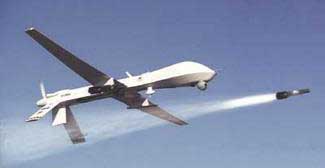
This morning, CNN reported that last Thursday (1 November 2012), Iranian fighter jets fired on a U.S. Predator drone. The Iranian government claims that the drone was fired on after it had entered Iranian airspace; however, the Pentagon’s official statement is that the drone was past the 12 nautical mile limit and was therefore over international waters when fired upon. The drone was not damaged.

With the amount of tension surrounding Iran and its nuclear program, the question of whether or not this action constitutes an armed conflict is interesting. An International Armed Conflict (IAC) is (1) a conflict between States that (2) leads to the intervention of armed forces (for more information on the types of armed conflicts, see the “LOAC Basics” tab above).

Determining whether or not an IAC could exist in this circumstance requires meeting both prongs of the definition laid out above.

(1) I think the fact that there is a conflict between the U.S. and Iran is a given, globally with issues over the Iranian nuclear program and locally over the issue of airspace. Further, (2) the intervention of armed force by Iran is also clear as the attackers were fighter jets flown by Iranian military pilots.

If we assume these two prongs are conclusively established, the question becomes whether or not we need two armed parties in order to have an armed conflict? CNN’s article calls the drone a “U.S. Air Force drone,” so for the sake of argument, we will say that this drone is considered to be a part of the U.S. military forces (thereby eliminating the other looming questions of who is driving and regulating the drone). However, if the drone is not armed and is only doing surveillance, is it considered a party to the “intervention of armed forces”?

In reality, the question of whether firing on the drone constitutes an IAC or not is moot as the armed conflict, if there was one, is now over, and its limited duration lead to no meaningful application for the rest of the LOAC. Nevertheless, as students of the law and observers of international relations, we must take note of this event, hoping that it is just another example of the growing tensions between the U.S. and Iran, and not the first shots fired in America’s next major conflict in the Middle East.

LOACBlog.com listed on State Bar of Texas’ website

by Travis Normand

I was informed today that the State Bar of Texas has listed the LOACBlog.com on the Texas law blog page of their website.  It is an honor to be included, and I would like to thank the State Bar of Texas for listing this site among so many other great legal blogs.

LOACBlog.com is one of 140 blogs that are listed on the website.  It can be found under the heading “International Law” and is currently the first, and only, international law blog listed!

You can see the entire list of blogs HERE.

Continue reading

The Use of Drones for Targeted Killings – A Decade Behind Us, A Decade to Go?

by Jessica Poarch

“What was once considered an immediate response to an exceptional threat to the United States is now a permanent and institutionalized feature of U.S. foreign policy. Perhaps by November 3, 2022, policymakers and the American people will have noticed.” ~ Micah Zenko (30 October 2012)

In his report to Foreign Policy, Micah Zenko reminds us that November 3rd marks the 10th Anniversary of U.S. use of Drones for Targeted Killings in the War on Terror – what he terms “America’s Third War.” He shows that this program has largely expanded over the last decade and argues that, unlike the wars in Iraq and Afghanistan, there is no sign that it will be discontinued in the near future.

You can read the entire article here

The US Drone Program and the Disposition Matrix

by Travis Normand

I received an email today from the WashingtonPost.com which contained links to the following resources, articles, and videos. The information concerned the U.S.’s drone program and the “Disposition Matrix.”  It is very interesting stuff and I wanted to share it here with anyone else who may be interested.

Plan for hunting terrorists signals U.S. intends to keep adding names to kill lists
By Greg Miller, Published: October 23
WashingtonPost.com

Over the past two years, the Obama administration has been secretly crafting a next-generation plan to capture and kill suspected terrorists, according to current and former U.S. officials.

The “disposition matrix,” revealed here in part one of a three-part Washington Post series on U.S. counterterrorism policies, reflects an effort by top national security officials to create an infrastructure capable of sustaining a seemingly endless war.

Continue reading this article HERE.

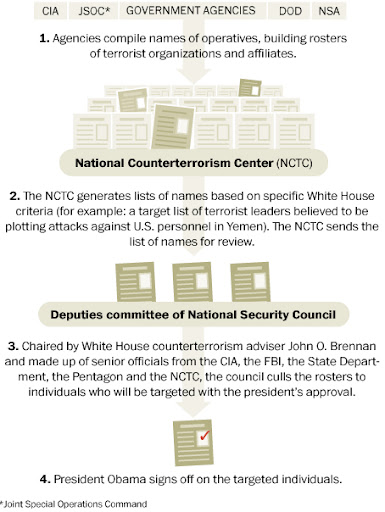
See also, The process behind targeted killing

See also, Tracking America’s drone war [Database of Drone Strikes]

The Process Behind Targeted Killing

LOAC Principles in Current Events: War vs Armed Conflict

by Jessica Poarch
October 4, 2012

Yesterday, mortars from the ongoing conflict in Syria crossed the border and killed 5 civilians in Turkey. In response, the Turkish government “pounded targets inside Syria on Thursday in retaliation…” In spite of the damage caused to the Turkish people, the Prime Minister of Turkey’s staff came out with statements against war with Syria. This is a clear example of the differences between “armed conflict” and “war.” Turkey has not made a formal declaration of war against Syria, therefore no state of “war” exists. However, an armed conflict does exist between the two nations. International Armed Conflict is defined as the “recourse to armed forces [by one or more states] against another state, regardless of the reasons or the intensity of [the] confrontation.” It is clear therefore that an International Armed Conflict exists between Turkey and Syria.