Tag Archives: LOAC

Article explaining the legal obligations associated with occupying Gaza

by Travis Normand
August 29, 2025

The following article does a pretty good job explaining the considerations and legal obligations associated with occupation and moving the civilian population.

Israel is planning to conquer Gaza City – what legal obligations will that incur?
By Jeremy Sharon, posted on August 22, 2025, at 12:05 pm and Updated at 1:21 pm, here: TimesofIsrael.com (or https://www.timesofisrael.com/israel-is-planning-to-conquer-gaza-city-what-legal-obligations-will-that-incur/)

Additionally, the following is a “podcast” discussion from the Daily Briefing (Times of Israel) with host Amanda Borschel-Dan and legal and settlements reporter Jeremy Sharon.

Daily Briefing Aug. 10: Day 674 – What would Israel’s legal duties be in a Gaza City takeover?
With Amanda Borschel-Dan and Jeremy Sharon, posted on August 10, 2025, here: TimesofIsrael.com (or https://www.timesofisrael.com/daily-briefing-aug-10-day-674-what-would-israels-legal-duties-be-in-a-gaza-city-takeover/)

New Article on Proportionality

by Travis Normand
August 8, 2025

For those who want a better understanding of the principle of Proportionality, please check out the following paper that was posted at the “International Law Studies – US Naval War College” page HERE.

The article is:

Proportionality: Can’t Live With It, But Can’t Live Without It
by Geoffrey S. Corn

Abstract:

“Perhaps no other word in the international humanitarian law lexicon evokes more interest and emotion than proportionality. How States implement the rule of proportionality is perhaps the most hotly debated aspect of international humanitarian law. The indeterminate nature of the rule allows for its meaning to conform to whatever its reader wants it to mean. This is a consequence of the variables related to key provisions of the rule: How do we assess military advantage? What makes an anticipated military advantage “concrete and direct”? And most problematic of all, what is the meaning of the term “excessive”? All of these concerns raise troubling questions. Can the proportionality rule truly matter without consensus on what amounts to non-compliance? Does the rule’s indeterminacy undermine its value as a legal tool? This essay will consider several aspects of the proportionality rule: first, why it still reflects a critically important principle of military operations despite its indeterminacy; second, its limited operational efficacy as a civilian risk mitigation measure; and third, why shifting the focus to the principle of constant care and the subordinate rule of precautions in the attack will advance the humanitarian interests of the law.”

Download the article in PDF format HERE.

Queen Rania’s Comments on Human Shields

Jordan’s Queen Rania appeared on CNN and had the following comments (see the text of her comments and/or the video, posted below; with these specific comments starting at about the 5:00 minute mark of the video):

“These evacuation orders, I do not believe are for the benefit of the Gaza civiliians. They are not the target audience; the rest of the world is. It is Israel’s attempt to try to legitimize their actions.”

And when it comes to human shields, I think we need to defer to international law. Of course, the use of human shields is criminal. But even if one side uses … puts a civilian in harms way, that civilian is still entitled to full protection under international humanitarian law. That is the global standard and no nation is exempt. So before firing any bullet, before dropping any bomb, it is the responsibility of the nation to weigh the risk to civilian life, and if that risk is disproportionate to the military target then it is deemed unlawful. And frankly, I find it really outrageous when Israeli officials audaciously dismiss Palestinian casualties as human shields. In a place like Jabalia, which is one of the most crowded corners of Gaza; Gaza being one of the most densely populated spots on Earth … civilian death is not is not incidental, it is not accidental. It is a foregone conclusion, and that makes it a war crime.

Comments by Queen Rania of Jordan during interview with CNN’s Becky Anderson; posted to Twitter / “X” on November 5, 2023; see @BeckyCNN (these specific remarks start at about the 5:00 minute mark of the video).
Continue reading

Is the current conflict between Israel and Hamas a NIAC or IAC?

by Travis Normand
November 7, 2023

This is a summary of (some) the substance found in two other articles, one of which I have posted/shared previously. You can find both of these articles, in their entirety, posted here:

The article by Ken Watkin dives into a lot of interesting topics (including whether this conflict could be classified as an IAC; depending on the degree of support, if any, Iran is providing to Hamas); but my point here in this post is to examine the question of whether the current conflict between Israel and Hamas is a NIAC or IAC. I am doing so by summarizing what is in the two articles posted above.

Continue reading

Great Article on the current Israel / Hamas situation

by Travis Normand
November 3, 2023

I highly recommend the following article on the Israel / Hamas situation. I will post more about it (along with my thoughts) when I have more time. For now, I just wanted to share a link to the article for anyone who might be interested.

OUPBlog: Drone Killings

by Jessica Poarch Hernandez

The OUPBlog recently posted a piece by Sascha-Dominik Bachmann entitled Drone Killings. Adapted from an article published in the Journal of Conflict and Security Law, this post argues that  the use of drone technology “has direct implications for the morality of armed conflict and combat” because it puts too much distance between the shooter and the target. He then goes on to argue that the U.S. Government should reevaluate its use of Drone Technology and concern itself more with the broad issue of collateral damage.

Read the post here.

The opposite of peace is chaos, not war.

by Travis Normand

I stumbled upon the following quote and thought it was highly relevant to the study of the LOAC.

[Emphasis Added]

This week I have been doing some reading for a class I’m taking at ESR called Images of God. While studying the image of God as Warrior my class read an article by an Old Testament professor at Harvard, Paul Hanson, who wrote about the concept of Peace as Shalom in the early Old Testament. This concept doesn’t translate directly into the way we use the English version of it. Hanson said many interesting things -among them that the opposite of peace is not war. It is chaos. Webster’s Dictionary gives a definition of “chaos” as a word that means the disorder of formless matter and infinite space. Hanson described the ancient Israelites sharing with their neighbors over the cook pot, their basic view that the world was situated precariously between order and chaos. Order is defined as a life-enhancing condition which the creator God maintains by holding the unruly forces of chaos in check. [1]

Continue reading

Targeted Killings of Americans: Three Things to Know [CFR.org]

by Travis Normand

The following video and article were originally created and posted by CFR.org.  You can visit their site HERE.

As for the three points discussed by Matthew C. Waxman (in the following video), I think the first point is the most important. After all, whether or not the U.S. is at war determines if the LOAC paradigm is applicable to the situation.

Continue reading

Obama administration to codify U.S. drone policy

by Travis Normand

I found this article on NYTimes.com about how the Obama administration is looking to codify the U.S. drone policy. The article is quite fascinating and addresses a few of the larger complaints and challenges concerning drone usage.

Click HERE to read the entire article.

While reading the article, I had several thoughts which I wanted to address here.

My first thought came after reading the following quote:

“One of the things we’ve got to do is put a legal architecture in place, and we need Congressional help in order to do that, to make sure that not only am I reined in but any president’s reined in terms of some of the decisions that we’re making,” Mr. Obama told Jon Stewart in an appearance on “The Daily Show” on Oct. 18.

In the quote above, President Obama states that he needs “Congressional help” in order to put a legal architecture in place for the drone policy. My first thought was that as Commander in Chief, the President has historically been very careful to keep congress out of the decisions of who was designated an enemy combatant.  It will be interesting to see how much congressional help he will accept and what this will do to any current precedent.

Continue reading

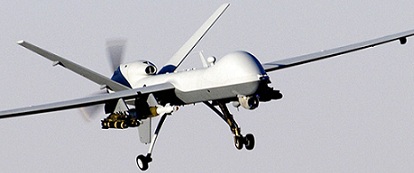
Iran Fires on US Predator Drone: An Armed Conflict?

by Jessica Poarch

This morning, CNN reported that last Thursday (1 November 2012), Iranian fighter jets fired on a U.S. Predator drone. The Iranian government claims that the drone was fired on after it had entered Iranian airspace; however, the Pentagon’s official statement is that the drone was past the 12 nautical mile limit and was therefore over international waters when fired upon. The drone was not damaged.

With the amount of tension surrounding Iran and its nuclear program, the question of whether or not this action constitutes an armed conflict is interesting. An International Armed Conflict (IAC) is (1) a conflict between States that (2) leads to the intervention of armed forces (for more information on the types of armed conflicts, see the “LOAC Basics” tab above).

Determining whether or not an IAC could exist in this circumstance requires meeting both prongs of the definition laid out above.

(1) I think the fact that there is a conflict between the U.S. and Iran is a given, globally with issues over the Iranian nuclear program and locally over the issue of airspace. Further, (2) the intervention of armed force by Iran is also clear as the attackers were fighter jets flown by Iranian military pilots.

If we assume these two prongs are conclusively established, the question becomes whether or not we need two armed parties in order to have an armed conflict? CNN’s article calls the drone a “U.S. Air Force drone,” so for the sake of argument, we will say that this drone is considered to be a part of the U.S. military forces (thereby eliminating the other looming questions of who is driving and regulating the drone). However, if the drone is not armed and is only doing surveillance, is it considered a party to the “intervention of armed forces”?

In reality, the question of whether firing on the drone constitutes an IAC or not is moot as the armed conflict, if there was one, is now over, and its limited duration lead to no meaningful application for the rest of the LOAC. Nevertheless, as students of the law and observers of international relations, we must take note of this event, hoping that it is just another example of the growing tensions between the U.S. and Iran, and not the first shots fired in America’s next major conflict in the Middle East.